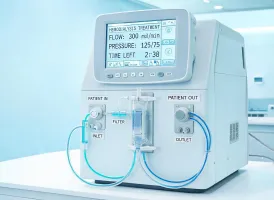
Dialysis Machine Planning
Review station capacity, operator training, disposables compatibility, alarm workflow, water quality assumptions, and preventive maintenance schedules before ordering a Nipro dialysis machine.
Compare Nipro dialysis machines, IVD laboratory equipment, bloodline assemblies, and renal support consumables with clear throughput, service, validation, and documentation expectations.
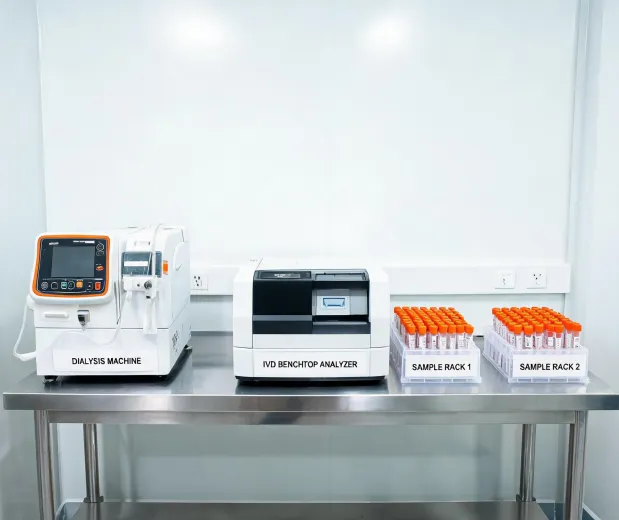
Each tab groups the figures a biomedical engineer, laboratory director, or renal operations buyer usually asks for before requesting a quote.
| Clinical chemistry | Batch and stat workflows reviewed by tests per hour, sample carryover, calibration interval, and reagent open-vial stability. |
|---|---|
| Dialysis stations | Station planning covers machine count, water treatment assumptions, bloodline compatibility, and staff training cadence. |
| Consumable flow | Par levels can be modeled by weekly treatment volume, distributor lead time, and lot traceability requirements. |
| LIS connection | HL7 v2.5.1 ORU result messaging, barcode accessioning, and middleware mapping are documented before go-live. |
|---|---|
| Quality control | QC review includes Levey-Jennings trend review, Westgard rules, proficiency testing cadence, and audit export format. |
| Data governance | Access roles, event logs, device identifiers, and complaint-handling channels are mapped for regulated facilities. |
| Install validation | Site readiness, IQ/OQ/PQ records, user training rosters, and acceptance criteria are gathered into one handover pack. |
|---|---|
| Preventive maintenance | PM windows are planned around clinical load, replacement parts, calibration tools, and documentation retention. |
| Escalation | Support routing separates operator questions, biomedical service events, LIS interface issues, and distributor logistics. |
Review station capacity, operator training, disposables compatibility, alarm workflow, water quality assumptions, and preventive maintenance schedules before ordering a Nipro dialysis machine.
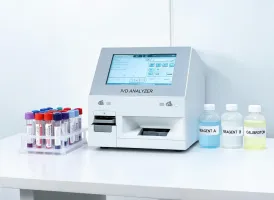
Compare throughput, sample handling, QC, calibration, reagent stability, and LIS interface assumptions for laboratories that need practical validation support.
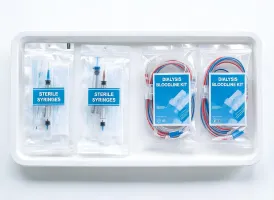
Set par levels, distributor replenishment rules, lot traceability, and packaging documentation for high-use clinical supplies.
Requests start with capacity, interface, consumable, and service facts instead of generic brochures.
IQ/OQ/PQ, QC, traceability, and training records are scoped before implementation.
Interface assumptions are documented early so middleware work does not appear late.
Dialysis station plans include staff steps, bloodline use, alarm review, and PM windows.
Supply terms, lead times, lot records, and substitution rules are stated plainly.
Support routing separates clinical, service, interface, and documentation questions.